Published November 16, 2026Updated November 16, 2026
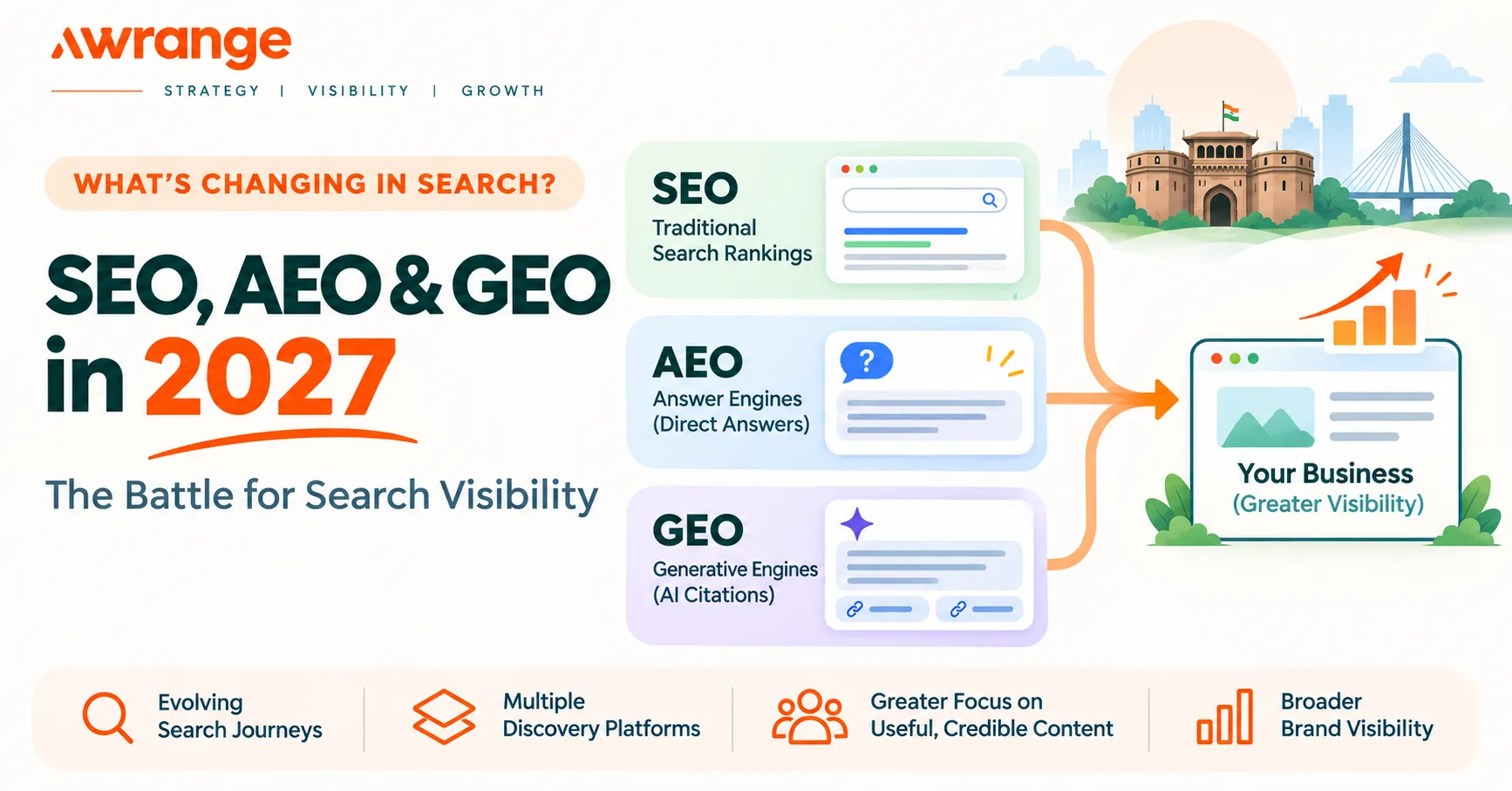
Summary: Search is no longer one list of blue links. People still use Google to compare and discover businesses, but they are also asking AI tools to explain options, shortlist providers and recommend next steps. In 2027, businesses will need to think about traditional search, answer engines and generative engines together. The opportunity is not to chase every new acronym. It is to make the business useful, understandable, and credible wherever potential customers search.
A customer looking for an agency might search Google, compare websites and read reviews. Another might ask ChatGPT for agencies in a city, then check the sources it references. Someone else may use Google’s AI Overview before visiting a provider.
These journeys can overlap. Google rankings still matter; AI-generated answers add another discovery route. Businesses need to be findable across these experiences without treating each platform as a separate marketing project.
That is the context behind AEO vs GEO vs SEO 2027. They share a foundation: useful information, accessible pages, expertise, and verifiable business details.
The terms describe different emphases.
| Approach | Main focus | What visibility can look like |
| SEO | Improving a website’s visibility in traditional search | Organic listings, local results and relevant landing pages |
| AEO | Making information easy for answer engines to understand and use | Direct answers, featured snippets and answer-style results |
| GEO | Improving the chance that a brand or its content is referenced in generative engine responses | AI citations, source links and brand mentions |
SEO remains the base. AEO focuses on questions and concise, accurate answers. GEO considers how generative engines retrieve, interpret and cite information from different sources.
The boundaries are not fixed industry standards. Agencies use AEO and GEO differently, so ask providers what work and outcomes they mean by each term.
No one can predict how search platforms will change. Current platform guidance does, however, point to areas worth preparing for.
People can ask follow-up questions, add context and compare several options in one conversation. A search strategy built only around short, high-volume keywords may miss the detailed questions customers ask before choosing.
Cover real decisions: what a service includes, who it suits, what affects cost, how providers differ and what results are realistic. This supports search intent better than disconnected keyword pages.
Traditional search tracks rankings, impressions and clicks. Generative experiences may also surface pages as sources or citations.
A citation does not guarantee a visit, trust or sales. Make claims verifiable, cite credible evidence and keep business information consistent across trusted sources.
Pages that repeat common definitions offer little original value. First-hand experience matters: project examples, product details, research, expert explanations and clear limitations. A manufacturer can explain material specifications; a service firm can show its process and measured outcomes.
Pages need to be accessible to crawlers, with important information available as text. Maintain internal links, fix indexing issues and ensure structured data matches visible content. Google says existing SEO fundamentals remain relevant to AI Overviews and AI Mode; special AI files or schema are not required. Eligibility does not guarantee inclusion.
An effective AI search marketing strategy 2027 starts with customer questions and evidence, not a new tool or a complete website rewrite.
The GEO vs SEO strategy 2027 discussion should not be a choice between rankings and AI visibility. Businesses need a discoverable website and content that answers specific questions.
Not necessarily. The label matters less than the provider’s process and reporting.
An AEO agency 2027 should be able to explain how it identifies answer-led queries, structures useful responses and measures visibility in relevant answer experiences. A GEO agency 2027 should explain how it monitors mentions and citations and improves source-worthiness.
Answer engine optimisation services 2027 should involve more than question headings. SEO services for AI search 2027 are not a formula for guaranteed ChatGPT or Google AI citations.
Ask what platforms they monitor, which metrics they report and what is outside their control. No agency can guarantee an AI answer, citation or ranking.
Awrange’s published work shows how SEO can support different business goals.
For Absolute Bollywood, a London-based dance company, Awrange reports 20%+ growth in users, 22%+ growth in sessions and 13%+ growth in pageviews following its SEO campaign. The work included keyword research, content optimisation, local SEO and link building.
For Premium Transmission, Awrange reports more than 100 keywords on the first page, 37% year-on-year user growth and over 2,700 new enquiries. Its campaign focused on technical SEO, targeted keywords and high-intent landing pages.
These are outcomes reported in Awrange’s case studies. They demonstrate SEO results, not AEO or GEO citations. Agencies should be clear about what each case study actually measured.
SEO, AEO and GEO are not three disconnected replacements competing for a budget. They describe overlapping ways of improving discovery: ranking in search, answering questions and being represented in generative responses.
Prepare by answering customer questions, keeping the website accessible, demonstrating experience and maintaining accurate business information. Measure rankings, clicks, leads, conversions and available citation data.
Awrange lists SEO, AI SEO, GEO SEO and AI ranking and citation services. Explore its services and published case studies.
Yes. Google’s AI search features still rely on foundational SEO practices: crawlability, indexing, and useful content.
AEO focuses on making information useful to answer engines. GEO focuses on visibility and references within generative engine responses. The terms overlap and are not applied consistently across the industry.
No. Agencies can improve content quality, technical accessibility and brand information, then monitor available visibility signals. They cannot guarantee that an AI system will cite or recommend a business.
Start with audience, search behaviour and goals. Many foundational activities support all three, so a joined-up strategy makes more sense than disconnected services.
We Build Affordable
Most businesses in India go through two or three agencies before finding one that actually delivers results. The ones wh…
Read More
If you have searched “SEO company in Pune” recently, you have seen dozens of agencies all claiming to be the […]
Read More
For most early-stage startups in India, growth isn’t optional – it’s survival. But getting noticed online without draini…
Read More